The Same Thing, Only Different
|
|
|
|
|
The
Same Thing, Only Different
In 2012 both AMT and Revell each released a model
kit of a Chevrolet van. The subject matter is not new, having been
offered multiple times previously, though the Revell kit was originally
under the Monogram label.
Quick basic comparison:
AMT: 1/25 scale long wheelbase.
Revell: 1/24 scale short wheelbase.
In depth comparison:
Both models depict a G30, which would be a one ton van, but there
the similarity ends.The Revell, in 1/24 scale, represents a short
wheelbase van with integral flared wheel openings. These are inaccurate
for a stock van, but were appropriate for the first Monogram release,
which was done in 1977 as a four wheel drive Off Road van, with Goodyear Tracker AT tires on eight spoke chrome
wagon wheels.
Monogram then released the van as a two wheel drive
with simple but accurate independent front suspension, in two football
themed versions, and more recently, as a race team tow vehicle with a
trailer. These kits, like the new Revell model, had Chevy five slot
rally wheels, and P255 60 R15 Goodyear GT radial tires. They look
good - as long as we ignore the fact that the real G30 van would have had
16.5 inch wheels, and more than five lugs.
Revell labels their van as a 1977 which, while
believable, is a moot point because since their 1970 introduction, the
real vans were virtually unchanged for several years. Other than the
windshield and the front door glass, there are no windows along the
sides, or at the rear. Decals are included for a plumbing company, and
some modern graphics for a custom paint shop. The plumber decals may be
more outrageous than the custom graphics.
The AMT, in 1/25 scale, represents a long wheelbase
G30, also windowless, and repeats a name applied to an earlier release
of a van kit: "Vantasy". The full name of this latest version is Dirty
Donnies Custom Chevy Van. Dirty Donnie apparently being an artist of some repute who lent his hand to the two
sheets of custom graphics
decals included in this kit.
The AMT G30 Chevy van has been produced in numerous
guises throughout the years, having first been done in approximately 1970.
Initially the kit offered the option of a panel version, or a window version, with separate
side panels for each, and windows in the rear loading doors. A further
option of the early kit was as an emergency vehicle, which could, if a modeler chose, accompany other
similar vehicle models in AMTs line up. The others being a 1970 Chevy Impala Fire
Chiefs car, and three American LaFrance fire trucks.
Subsequent releases of the G30 by AMT were offered
as panel vans only, and eventually lost their rear door windows. Some
versions had a porthole window cut into the end of each side panel, and
included various custom accoutrements and graphics.
Like AMTs original release of the G30, this new
kit includes stock (though with only five lugs) open wheels and stock
hubcaps. Also included is the option of chrome five spoke mag wheels.
The porthole window glass is present, but the actual holes are not cut
out of the body (they had been in some prior releases). This kit, with
the previously mentioned TWO sheets of elaborate graphics, some add-ons
appropriate for, and indeed is labeled as a Custom van, offers
builders the option of a stock version, but does not include any
commercial decals. It does,
however, include a mini catalog of 2011-2012 AMT model kits.
Conversely, the Revell kit does include two
commercial decal sets, though the flared wheel arches and well done
(though technically incorrect for a one ton) rally wheels seem more at
home with the custom painting shop decals. Of course, removing the G30
designation from the body, one could claim that the van is a lighter
capacity G20, and then the (15") rally wheels could then be
conceivable.
That is of course the beauty of a scale model: One
can make it anything he or she wishes it to be.
|
|
|
|
|
|
-Jim Amado |
|
|
|
Back to Top |
|
| |
|
|
|
|
|
TKM Models
For too many years I've heard too many "complaints" about TKM Models. I began carrying TKM models in my shop almost thirty years ago. They, along with the late Sam Miller's models, were among - if not the - earliest resin car models available, and they depicted subject matter no one else offered at the time.
Were they crude? Certainly, when compared to a mass produced, injection molded plastic kit, which had chrome plated parts, rubber tires, clear glass, and to which most of us were accustomed. It cost the major model companies millions of dollars to produce a model kit of the caliber which we had become accustomed to. For the most part, they produced models which they felt would give them a good return for their investment, which meant there were and are many others which we may like to see, but which they deem economically unfeasible.
The early resin kits were different. Perhaps out of our comfort zone. But where else could we find models of the cars they represented? I used to purchase two or three at a time for resale in my shop, because I wanted to offer potential buyers a greater selection of models which I knew existed, than those which the major model companies produced.
Not surprisingly, interesting a customer in one of these models, even though it was the only replica of the vehicle which they had asked about, was a challenge. So I built some for display. I didn't know about Bare Metal Foil back then, so silver paint was what I used for the models "chrome trim".
Here are some examples of long ago built TKM models. Neither contest winning, nor museum quality, but in the hands of a more talented, or more patient builder, using more modern techniques, they could be.
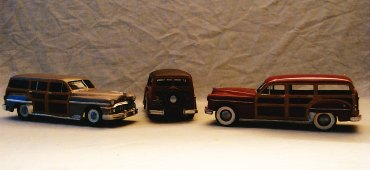
(L) 1950 DeSoto
(Center) '48 Chevrolet
(R) 1949 Dodge
|
|
|
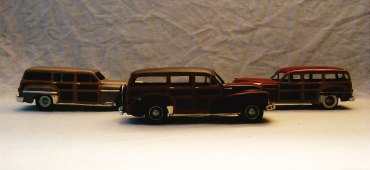
(L) 1950 DeSoto
(foreground) 1948 Chevrolet
(R) 1949 Dodge
|
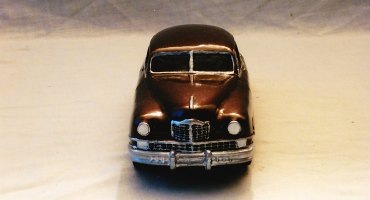
1948 Packard
(front) |
|
| |
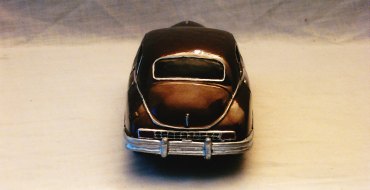
1948 Packard (rear)
|
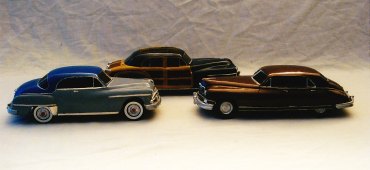
(L) 1952 Plymouth Cranbook Belvedere
(center) 1946 Chrysler Town & Country
(R) 1948 Packard Touring Sedan
|
|
| |
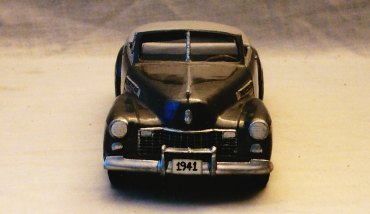
1941 Cadillac (front) |
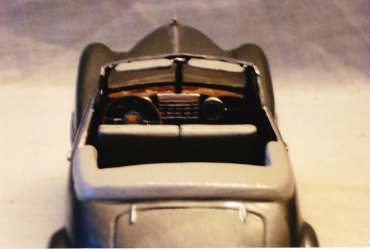
1941 Cadillac
|
|
| |
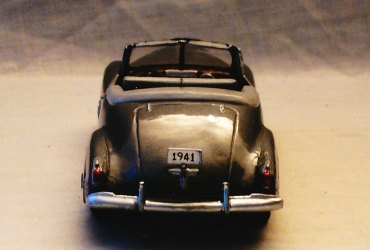
1941 Cadillac (rear)
|
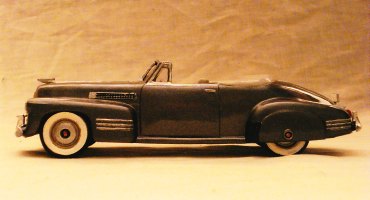
1941 Cadillac Series 62 Convertible Coupe
|
|
| |
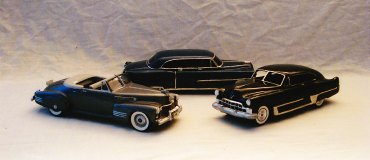
(L) 1941 Cadillac Series 62 Convertible Coupe
(center) 1950 Cadillac Series 75 Limousine
(R) 1949 Cadillac Series 62 Club Coupe |
Now a word about Tom Mills himself. I met him many years ago, after I had been purchasing his models, at an Old Town Escorts model show in Chicago. He's an interesting gentleman, and in my opinion, an artist. In the course of the show, he was converting an MPC plastic Chevrolet Monte Carlo into a Pontiac Grand Prix. Admittedly, his slush casting is not state of the art, but I have to say that I, and I doubt that I'm the only one, am glad to have TKM models available to us. We all know that in recent years there have been some better models of some of Tom's offerings, but they came twenty or thirty years later! Let's stop bashing TKM Models, and give the man the credit he is due; he's been an important part of our hobby, offering a variety of models otherwise unavailable. If a modeler is not up to the challenge of a TKM model, so be it. But there are those of us who remain grateful to Mr Mills for his products, and his efforts.
-Jim Amado
> Back to Top
|
Give 'em A Chance, Will Ya'?
|
|
Give 'em A Chance, Will Ya'?
People are badmouthing the soon to be new Trumpeter Ford Falcon models before they are even made!
Model cars have been my hobby for more than fifty years, and my business for more than thirty years. I have seen many models come and go. I have built many. I have "attempted" to build, and/or have "contemplated" building many. Permit me to clarify, or at least expound upon, that last statement.
In the 1960s and '70s Revell made models of some really neat cars! Yet Revell kits were among my least favorite. The subject matter intrigued me. Sometimes, even the working features were tempting. I purchased models of the vehicles I liked, but often put off beginning the assembly process. They often had lots of small pieces, too many "chrome" parts which shouldn't have been "chrome", and no bracing to align the bodies which had opening everything. All of this didn't mean they were bad models, just, perhaps, beyond my capabilities, or my comfort level.
To their credit, Revell has not only survived, but has become arguably the best "American" model company, offering not only the largest variety, but also the newest models of desirable cars. Some new tooling of previously offered models, and some new, never before offered. I, too, have survived and continue to purchase, and build, Revell kits.
IMC was another company to offer what, at the time, were incredibly detailed models. Again the subject matter shot arrows into my heart, but their complexity pained my brain, with a multitude of parts, excessive chrome, etc.
More recently Gunze Sangyo, and others, including some "cottage industry" or "aftermarket" model companies have offered excessively detailed, multi-media kits. Many of these kits are desirable in their subject matter, but require substantial investments of both time and capital.
Most recently, Galaxie LTD. offered the '48 Chevies ("Must haves" in my book!), and Testors released the new Chargers in variations, all with much more detail than I personally require to float my boat, but attempting to appeal to modelers who desire such intricacies. The Chevies were about $26.00 each, and the Chargers $30.00 each. Not, in my opinion, out of line for what they offer. AND, they are accurately replicated.
Having admitted previously to not being a high tech modeler, and not enjoying assembling "130 pieces for one shock absorber, which no one will see when the model is finished", I would conclude that any difficulty in assembling the aforementioned models is a problem with me, and not the model companies involved.
I will further admit that I was, and would be, perfectly satisfied with simplified construction such as the 1958 - 1964 "annual" kits exhibited. In fact, recently took a first place award in a slammer class with a fifty year old model, which I built about thirty years ago.
There are however some who seek, and claim to enjoy, more complex models. It seems to me, at least some of these individuals are more often "looking for something to do", as they recuperate from an injury or surgery, rather than being "model builders" per se.
Knowing the history I have just related, it probably comes as no surprise that I have not built either of the Trumpeter '60 Pontiacs, either of their '63 Novas, nor their '78 Monte Carlo. In addition to their complexity or level of detail, depending upon an individual's viewpoint, as an old timer in the hobby I have those models in my collection from their respective years. I have, however, built one Trumpeter car kit: The Chinese limousine.
Regarding their price, however, I believe we should put the facts into perspective. Until recently, an original 1960s issued kit, supposedly had substantial value far exceeding the price of the Trumpeter kits. Further, the Trumpeter kits allegedly offered features not found in models made forty years previously. Accuracy, however, was an issue in some areas. (Those Pontiac 8 lug aluminum wheels were horrible!) Yet the fact remains that Trumpeter offered modelers an opportunity to acquire, if one so desired, models of cars which previously had been obscure, expensive, and difficult to obtain. I know for a fact that the Nova was a model often requested by people we met both here at the shop, and at shows we have attended. On that basis, I would have thought that the Trumpeter model would have sold better than it did. Price, at the time of its release, being thirty-five dollars, vs. a then current domestic kit @ around $12.00 - $15.00, certainly was an issue, despite its ready availability and desirable subject matter. The "logic" apparently did not support the price.
Now, however, with current Revell kits dancing all over the price board, would a Trumpeter kit fare any better? How much would a modeler comfortably play for a given replica of a vehicle he or she admires? Revel models are, for reasons unknown, priced at $16.00, $19.00, $23.00, and $25.00. The '62 Chevy is $25.00, while the '66 Chevy is $20.00. Both were released in 2010. The '62 has some optional parts. Apparently the '66 does not. Point being, prices are now not that far away from the Trumpeter kits...if the future releases are priced like their predecessors.
I, for one, am excited about the two proposed Falcons. It's been forty-six years since the Falcon Sprint has been offered. Sure, we old-timers, if we wanted one, probably already have it...and paid $2.00 or less for it back in the day. Isn't it possible someone who may not have acquired one back then, or who may have acquired an affinity for the car since then, may want one? The Ranchero, depending upon the price, I may purchase and build myself. Yes, it has been offered in resin, but I never got one, and it was never done before in a plastic kit, so it may find some buyers among others besides myself. However, that "never offered in a kit before" argument didn't seem to do much for Trumpeter's '78 Monte Carlo kit, so we'll see.
Who knows? Trumpeter may do them right! Let's give them a chance!
-Jim Amado
> Back to Top
|
|
|
|
NOVA
One Nova knows what a new model kit will be like until the box is opened and the kit inspected firsthand.
Fortunately, model magazines review new kits so we can get an idea of what to expect, and with this
information decide if we want to purchase the particular model.
The buzz surrounding the Nova models recently released by Revell is not surprising, given the popularity
of the actual vehicle. The reviews have been many, and the kits are certainly welcome and desirable.
Comparisons with the old AMT issued Nova SS kit are not surprising as they, the old AMT kit, and the new
Revell kit, are the only two 1/25 scale models of the '68 through '72 Nova body style.
Reviewers and purchasers of the new Revell kit should keep in mind several factors before issuing a blanket
statement of how superior the Revell kit is over the AMT kit. Among these factors are the following:
- They represent different years of Chevrolet Novas. Throughout its existence, the AMT kit has been called
various years. In an attempt to determine the correct and actual year it represents, several years ago I had
compared original Chevrolet/GM issued Nova sales literature from the years 1968 through 1972. From this
endeavor I concluded that the AMT kit most closely resembles a 1971. Kit # T365, the original issue of the
AMT kit, has been listed as a 1972, and at other times, a 1970.
- They represent different years of scale model production. We must realize that the AMT kit was released
over thirty five years ago! Technology has leapt ahead in the ensuing years, so, absolutely yes, the Revell
kit IS superior. Wouldn't we expect it to be, given the advances in technology? But this does not mean the
AMT model is bad.
- There was "method to (AMT's) madness". I keep hearing about the Revell kit's new one piece body, vs. AMT's
separate front fenders, and their poor fit. Guess What! When the AMT kit first hit the market, the fenders
lined up quite well. Is it a surprise that after 62 quadzillion reissues they don't fit quite as well?
HOW 'BOUT THIS: Do you even know WHY the fenders were separate? Here's a clue: Where on the body of
the AMT kit does the name "Nova" appear? NO PLACE! The ONLY place the Nova logo appears is on the fenders!
Why? Because AMT had also offered the PONTIAC version of the Nova, The Ventura II. Most of the parts, including
the interior and dashboard, were Nova parts, but the Pontiac nose/grilles, etc., and the FRONT FENDERS were Pontiac.
Let's not bad mouth a good kit because it is showing its age.
- With all due respect, despite technological advances, the new Revell kit is not flawless either. Somewhere
between design and production the gas tank was misinterpreted. As in real life, nothing is perfect.
The tires in the new Nova kit are "generic no names", as I believe the esteemed Bill Coulter called them.
As he noted, this makes it easier for modelers to put their choice of tire brand on them. Thankfully,
they're not the same incorrect tires which had been included in the Revellogram '67 Corvette kits. Those
tires, at first glance, appear to be no names, but on closer inspection they are seen to be Michelin TRX tires,
which were a special "metric" tire and wheel option for '80s Mustangs; back in the day, the real TRX tires only
fit TRX wheels.
There was a third scale model of the '68 - '72 era Nova, and an excellent model it was, but I'd gamble several
modelers passed it by because of its size. Years ago Monogram offered a series, in 1/32 scale, which included a '70
Mustang Mach 1, '70-'71 Trans Am, and that wonderful '69-'70 Nova SS. The Trans Am and the Nova each had separate
exhaust and rear suspension/differential, opening hood, detailed engines and engine bays, among other features.
Great kits for their size!
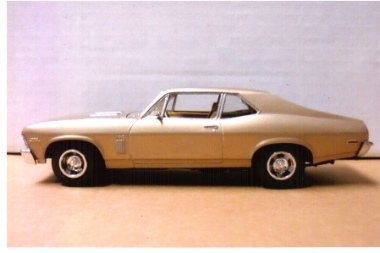
Monogram 1/32 scale Nova model |
|
| |
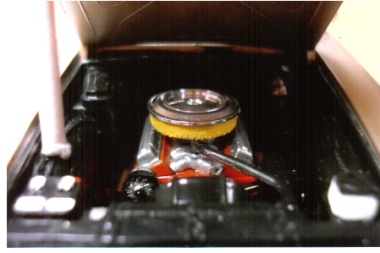
Monogram 1/32 scale Nova model |
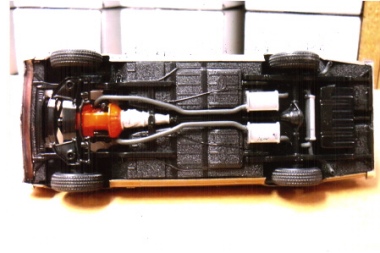
Monogram 1/32 scale Nova model |
|
-Jim Amado
> Back to Top
|
| |
|
WE DEAL IN CARS ON A SMALL SCALE
Jim Amado: The plastic surgeon, builder, collector, writer. |
| page
updated 2/7/2019
|
|